


O povoado de milhares de anos que cresceu sem ruas porque os moradores entravam nas casas pelo teto
As casas tinham tamanhos parecidos entre si, sinal de uma organização social pouco hierarquizada

O que você vai ver
- Onde fica Çatalhöyük e há quanto tempo o povoado foi habitado.
- Como as casas eram construídas umas encostadas nas outras.
- Por que os moradores entravam nas casas pelo teto em vez de pela porta.
- Quantas camadas de ocupação se acumularam ao longo do tempo.
- O que o tamanho parecido das casas revela sobre a organização social do povoado.
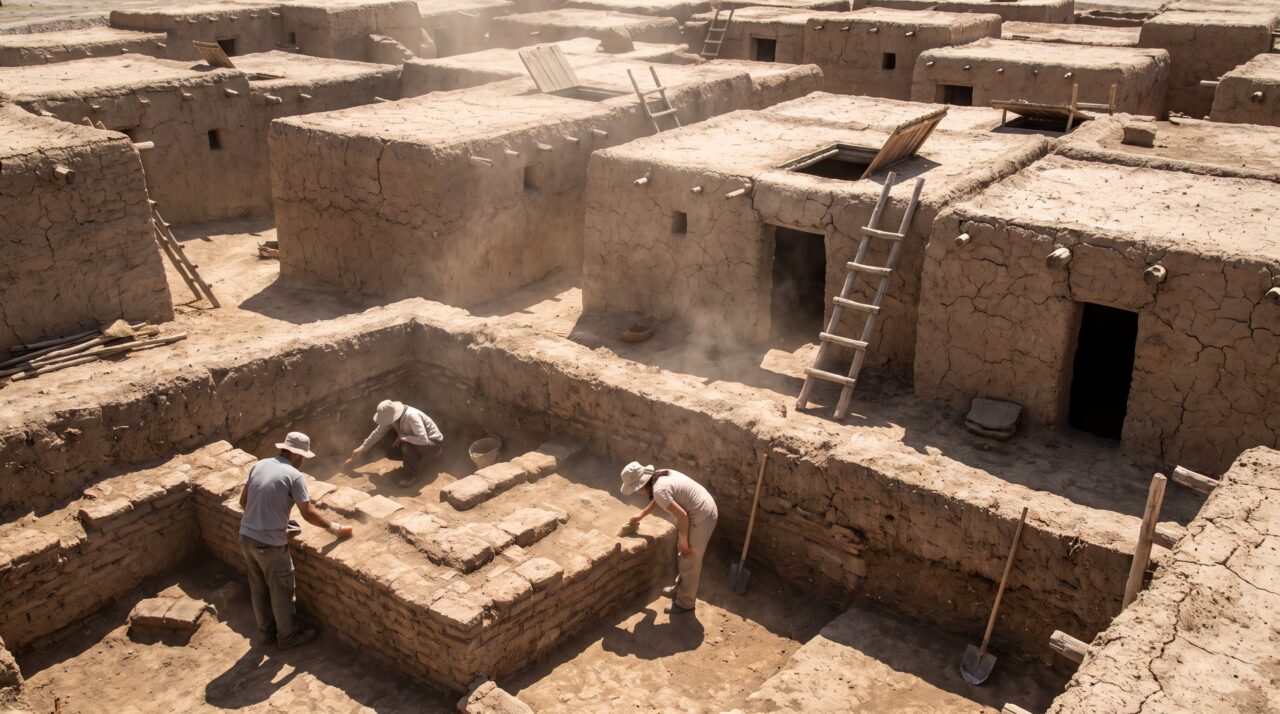
Um povoado neolítico na Turquia cresceu ao longo de mais de dois mil anos praticamente sem nenhuma rua, porque suas casas eram construídas encostadas umas nas outras e os moradores precisavam entrar nelas por aberturas no próprio teto.
Onde fica Çatalhöyük e há quanto tempo foi habitado?
Localizado na Turquia, Çatalhöyük é reconhecido pela Unesco como Patrimônio Mundial e teve seu montículo leste ocupado ao longo de cerca de 1.200 anos, entre 7400 a.C. e 6200 a.C., período neolítico, enquanto um montículo oeste vizinho concentra ocupação calcolítica posterior, entre 6200 a.C. e 5200 a.C., mantendo o mesmo local habitado por mais de dois mil anos ao todo.
The city of Çatalhöyük points to one of man’s most important transformations, from nomad to settled farmer… Çatalhöyük or Çatal Höyük (pronounced “cha-tal hay OOK”) is not the oldest site of the Neolithic era or the largest, but it is extremely important to the beginning of art. Located near the modern city of Konya in south central Türkiye 🇹🇷, it was inhabited 9000 years ago by up to 8000 people who lived together in a large town. Çatalhöyük, across its history, witnesses the transition from exclusively hunting and gathering subsistence to increasing skill in plant and animal domestication. We might see Çatalhöyük as a site whose history is about one of man’s most important transformations: from nomad to settler. It is also a site at which we see art, both painting and sculpture, appear to play a newly important role in the lives of settled people. Çatalhöyük had no streets or foot paths; the houses were built right up against each other and the people who lived in them traveled over the town’s rooftops and entered their homes through holes in the roofs, climbing down a ladder. Communal ovens were built above the homes of Çatalhöyük and we can assume group activities were performed in this elevated space as well. Like at Jericho, the deceased were placed under the floors or platforms in houses and sometimes the skulls were removed and plastered to resemble live faces. The burials at Çatalhöyük show no significant variations, either based on wealth or gender; the only bodies which were treated differently, decorated with beads and covered with ochre, were those of children. The excavator of Çatalhöyük believes that this special concern for youths at the site may be a reflection of the society becoming more sedentary and required larger numbers of children because of increased labor, exchange, and inheritance needs. Art is everywhere among the remains of Çatalhöyük—geometric designs as well as representations of animals and people. Repeated lozenges and zigzags dance across smooth plaster walls, people are sculpted in clay, pairs of leopards are formed in relief facing one another at the sides of rooms, hunting parties are painted baiting a wild bull. The volume and variety of art at Çatalhöyük is immense and must be understood as a vital, functional part of the everyday lives of its ancient inhabitants. Many figurines have been found at the site, the most famous of which illustrates a large woman seated on or between two large felines. The figurines, which illustrate both humans and animals, are made from a variety of materials but the largest proportion are quite small and made of barely fired clay. These casual figurines are found most frequently in garbage pits, but also in oven walls, house walls, floors and left in abandoned structures. The figurines often show evidence of having been poked, scratched or broken, and it is generally believed that they functioned as wish tokens or to ward off bad spirits. Nearly every house excavated at Çatalhöyük was found to contain decorations on its walls and platforms, most often in the main room of the house. Moreover, this work was constantly being renewed; the plaster of the main room of a house seems to have been redone as frequently as every month or season. Both geometric and figural images were popular in two-dimensional wall painting and the excavator of the site believes that geometric wall painting was particularly associated with adjacent buried youths. 🎥© time.vector © Dr. Senta German #archaeohistories
— Archaeo – Histories (@archeohistories) August 23, 2026
Como as casas eram construídas?
As casas de tijolos de barro eram erguidas parede com parede, praticamente coladas umas nas outras, formando um aglomerado denso de construções sem espaço livre suficiente entre elas para a existência de ruas convencionais, arranjo que definiu toda a estrutura urbana do povoado ao longo dos séculos de ocupação contínua.
Por que entravam pelo teto?
Sem ruas entre as casas, a única forma prática de acesso era por aberturas deixadas no teto, alcançadas por escadas, prática que também pode estar ligada à localização do povoado perto do rio Çarşamba, sujeita a enchentes periódicas, hipótese que associa esse formato específico de construção a uma estratégia de proteção contra a água que eventualmente subia ao nível do solo.
Quantas camadas de ocupação se acumularam?
Ao longo dos séculos, sucessivas reconstruções feitas diretamente sobre as ruínas das casas anteriores acumularam 18 camadas distintas de ocupação neolítica, processo que elevou gradualmente todo o terreno até formar um monte artificial de cerca de 20 metros de altura, resultado direto de milhares de anos de reconstrução contínua no mesmo local exato.
SOKAKLARI OLMAYAN ŞEHİR: ÇATALHÖYÜK! KAPIDAN DEĞİL, BACADAN GİRİYORLARDI! 9000 yil önce Konya Ovası’nda kurulan Çatalhöyük, dünyanın ilk büyük metropolüydü. Ama bir gariplik vardı: Şehirde hiç sokak yoktu! Evler bitişik nizam yapılmıştı. Halk çatılarda yürüyor, evlerine damdaki delikten iniyordu. Daha da garibi: Ölülerini evlerinin tabanına gömüyor, her gece onların üzerinde uyuyorlardı. evleri birbirine yapışık Anadolu’nun bağrından çıkan bu dünya mirasını izleyin. Çatalhöyük Müzesi’ne giden var mı? Neler deneyimlediniz ? Elinizde çektiğiniz fotoğraflar varsa lütfen yorumlarda paylaşın lütfen.
— Özgür Toprak (@ozgurtoprak833) January 9, 2026
O que o tamanho das casas revela sobre a sociedade?
Segundo a Unesco, as casas de Çatalhöyük têm tamanhos amplamente parecidos entre si, padrão que os pesquisadores interpretam como um possível indício de uma organização social relativamente igualitária, sem grandes diferenças visíveis de status ou riqueza expressas na arquitetura das moradias individuais do povoado.
Formas inusitadas de organizar o espaço urbano também aparecem no relato sobre o anel subterrâneo de 27 quilômetros que acelera partículas sob a fronteira de dois países.
Mais detalhes sobre o sítio estão disponíveis na página oficial da Unesco.


Os comentários não representam a opinião do site; a responsabilidade pelo conteúdo postado é do autor da mensagem.
Comentários (0)